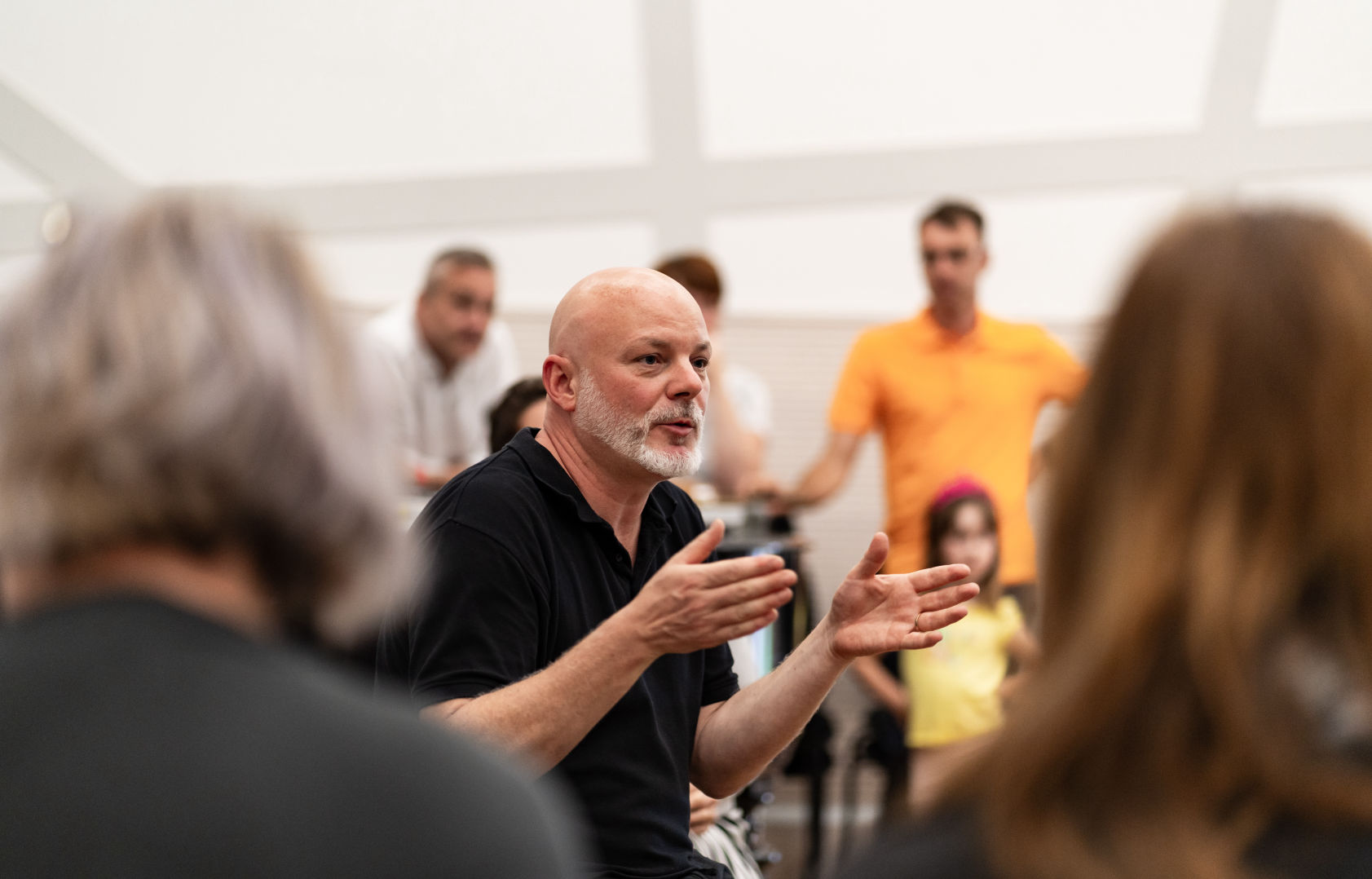
Maurice de Martin: making time playable!
Photography: Kevin Obst
CHRONARTA is led by Maurice de Martin—musician, composer, artistic researcher with MA "Contemporary Arts Practice" and university lecturer. For more than two decades, his work has moved at the intersections of art, science, education, and institutional practice.
The foundation of CHRONARTA lies in his long-standing, continuous engagement with highly developed forms of time practice across a wide range of artistic and non-artistic contexts: universities, clinics, international institutions, artistic production environments, and transdisciplinary research projects. In all of these fields, time was not assumed as a given framework, but understood and tested in practice as a shapeable medium.
Over nearly two decades, MdM developed teaching formats in inter- and transdisciplinary contexts, among others at the Brandenburg Medical School “Theodor Fontane” and at the Bern University of the Arts in Switzerland. Students from psychology, medicine, therapy, as well as virtually all artistic disciplines work with him on time as a space for knowledge, experience, and action: learning as an interactive process, attention as practice, rhythm as a structuring principle of insight. These formats are transferable, conceived for the long term, continuously developed, and characterized by an unusually high density of positive resonance.
In parallel, MdM worked for several years as a cultural consultant with the United Nations in Europe, Africa, and the United States. Participatory works situated between institution and society gave rise to temporally structured spaces of interaction in which transitions—between individual and organization, everyday life and politics—were consciously shaped. Here, time practice functioned as a mediating element between highly divergent power structures.
MdM’s artistic practice is closely linked to collective and performative modes of work. As a long-standing member of one of the world’s most important ensembles for contemporary music, Zeitkratzer, and as musical director at the Berlin Schaubühne, he engaged intensively with principles of rehearsal, repetition, presence, and decision-making under high production pressure in complex and volatile constellations. These experiences inform the understanding of rhythm and setting, as well as of authorship and the commons, that underlies CHRONARTA.
In professional scientific research contexts—among others within the FWF project Knowledge through Art / Erkenntnis durch Kunst—as well as in clinical-psychiatric projects such as Just Intonation, it became evident that time can be not only organized but also epistemically effective: as a medium in which perception, relation, and action repeatedly come into being and can thus be renegotiated. Even under extreme conditions—such as pandemic lockdown–driven international remote formats or exchange projects across closed borders—MdM’s understanding of a cultivated time practice proved to be a resilient foundation for collective process work.
CHRONARTA has emerged from the condensation of all these experiences. As a methodological practice arising from real work with real people in real situations, it seeks to be less a transferable model or standardized program than an evolving practice. The expertise of CHRONARTA is thus grounded in experience, in setting, and in the capacity to shape time in such a way that extraordinary action becomes possible.
Photography: Kevin Obst
Since 2018, MdM has developed and led teaching formats within the transdisciplinary framework of Studium Fundamentale (StuFu) at Brandenburg Medical School – Theodor Fontane.
The seminars addressed master’s students from psychology, psychiatry, therapy, and medicine, focusing on personality development, practices of attention, and the perception of time. Consistently fully booked at an early stage and evaluated with outstanding results, these formats positioned time itself as a didactic medium: learning as a process shaped both collectively and individually. (2018–present)
At the Y Institute of Bern University of the Arts, MdM conceived and realized more than twenty teaching formats over a period of twelve years at the intersection of art, science, and personality development. Particularly during the COVID period, two-year remote formats emerged that demonstrated how time—rhythmically and structurally shaped—can sustain relationship, attention, and collective learning even under conditions of spatial separation. (2010–2022)
As a "Cultural Consultant", MdM worked with the "United Nations" for over six years across its headquarters in Vienna, Geneva, Nairobi, and New York City. Within the long-term project Unknown Spaces, he developed—together with the artistic researcher Janina Janke—formats that brought UN staff and adjacent communities together in temporally structured spaces of encounter. At the center was the design of transition zones between individual and institution, politics and everyday life, each time evoking a distinct sense of “timing.” The project received special recognition from UN Secretary-General Ban Ki-moon as well as from the Directorate of the UN Headquarters in Geneva. (2010–2016)
For five years, MdM was a member of the Austrian FWF – Austrian Science Fund research project "Knowledge through Art" (Alpen-Adria Universities of Vienna, Graz, and Klagenfurt). Through collaboration between artists and scientists, the first systematic experiments with the ensemble rehearsal principle emerged: groups conceived as temporary instruments of knowledge, and time understood not as the framework of research, but as an active generator of knowledge. (2010–2015)
For five years, MdM served as musical director at the "Schaubühne am Lehniner Platz", one of Europe’s leading Theatres. Working with internationally renowned actors and directors, he created large-scale theatre music for complex spatial–temporal situations. Rehearsal, repetition, rhythm, and presence became central tools of time design under real production pressure. (2005–2010)
During the COVID-19 pandemic, Maurice de Martin led the project RADIO INSTANTOPIA: an eight-month media art and cultural exchange between young people from Kaliningrad and from Berlin and Brandenburg. Two groups who never met—and most likely never will—nevertheless developed an intense shared working process. "INSTANT·TOPIA" emerged as an imaginary, temporally generated place—an example of time design under conditions of impossibility. (2019–20)
For more than 25 years, MdM has been a permanent member of the internationally renowned avant-garde ensemble Zeitkratzer. Within this constellation, over 25 albums have been produced, widely regarded as reference points for contemporary sound and temporal aesthetics. Zeitkratzer functions as a radical time laboratory: hyper-complex structures, open forms, and the highest demands on attention, presence, and collective intelligence. The “ensemble principle” of CHRONARTA has naturally emerged from this long-standing practice of musical collectivity. (since 1999)
Conception and management of the "Just Intonation" project at the psychiatric department of the Immanuel Clinic in Rüdersdorf near Berlin. Over a period of nine months, Maurice de Martin worked together with director Janina Janke on action research in the clinic's everyday routine with patients and staff. Patients developed graphic scores of their mental states, which were rehearsed and premiered under their direction by an ensemble of doctors and professional musicians (including members of the Berlin Philharmonic Orchestra). The scientifically accompanied project exemplified how time design can enable new forms of relationship, action, and perception in a highly sensitive institutional context. The project was funded by the Montag Stiftung Kunst und Gesellschaft and Musikfonds e.V. (2018-19).

Offline Website Creator